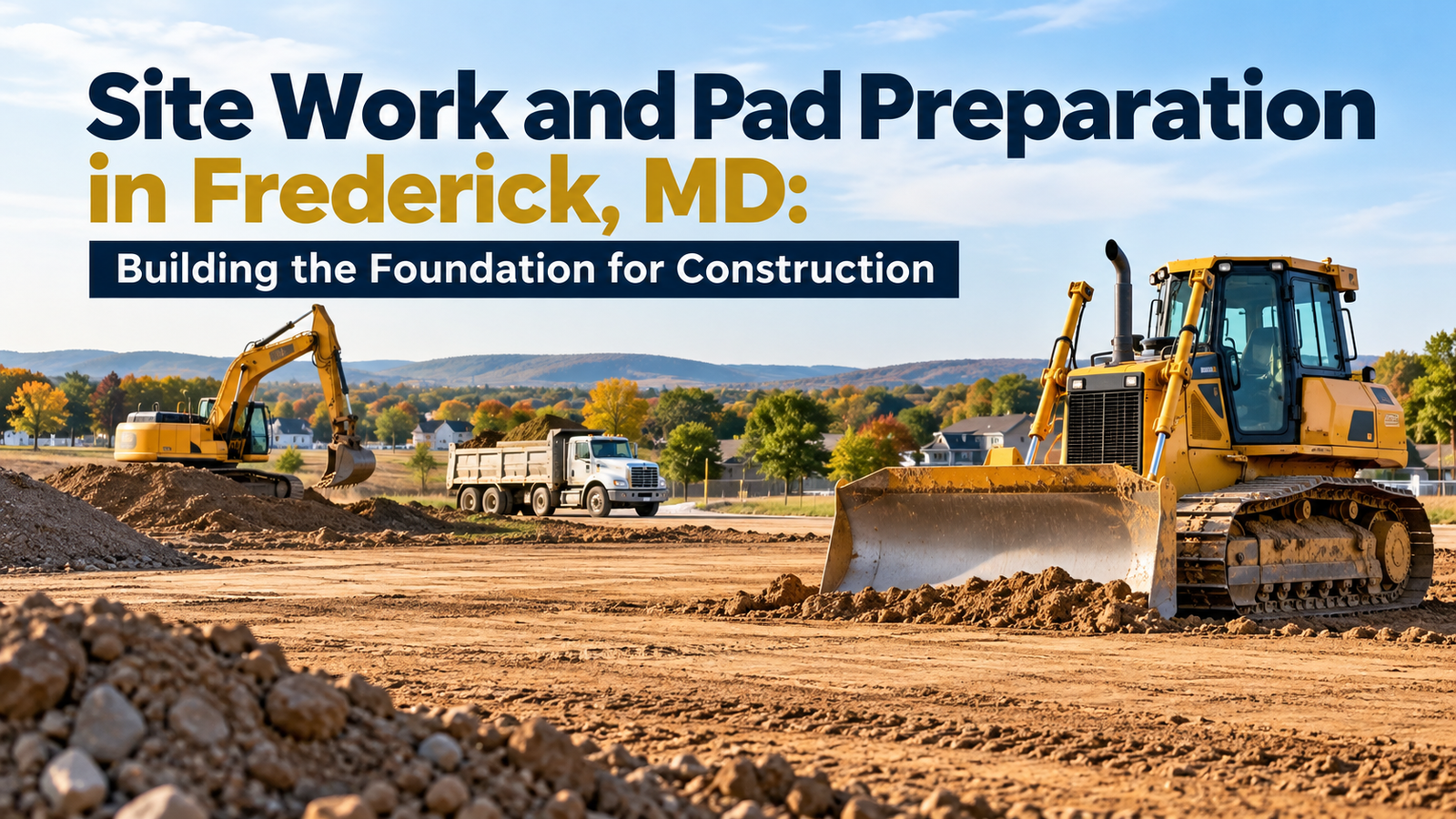

Every construction project in Frederick from a single-family home to a warehouse to a commercial center begins with site work and pad preparation. These are the earthwork processes that transform raw land into a prepared surface capable of supporting a structure and its associated infrastructure. In Frederick County’s varied terrain, which ranges from the river valleys of the Monocacy and its tributaries to the rolling farmland of the valley floor to the more rugged terrain near Catoctin Mountain, site work pad preparation Frederick requires both technical competence and familiarity with the region’s specific soil and geological conditions.
What Site Work Encompasses
Site work is a broad term that covers all the earthwork associated with preparing land for construction. It includes clearing vegetation, stripping and stockpiling topsoil, mass grading to establish design grades, cut and fill operations to achieve balance between excavation and fill placement, subgrade preparation, and the installation of underground utilities prior to building construction. Pad preparation is the final phase of site work the precise grading and compaction of the foundation area to meet the structural engineer’s specifications for bearing capacity and elevation.
The sequence matters. Utility installation storm drain, sanitary sewer, water main, and electrical conduit happens during site work, before final grade and before structures are built on top of the utility corridors. Getting this sequence wrong leads to expensive conflicts between building foundations and utility infrastructure. Frederick City and County both require engineered site plans that coordinate structures, grades, utilities, and drainage before grading permits are issued.
Frederick County’s Soils and Geologic Setting
Frederick County’s geology is dominated by the Great Valley section of the Valley and Ridge physiographic province. The underlying geology includes carbonite rocks limestone and dolostone in the valley areas, and metavolcanic and metasedimentary rocks in the foothills toward Catoctin Mountain. The limestone geology creates one of the most important site work challenges in this region: karst terrain.
Karst is a landscape developed from the dissolution of soluble rock limestone in particular. Over time, groundwater dissolves limestone along fractures and bedding planes, creating voids, sinkholes, and solution channels in the subsurface. Frederick County has documented karst terrain in multiple areas, and subsurface voids from karst dissolution can cause sinkhole formation during and after construction if not properly investigated and addressed.
Standard site work practice in karst-prone areas of Frederick County includes geotechnical investigation borings or probing to identify the depth to bedrock and detect near-surface voids before grading begins. Maryland’s Department of Natural Resources publishes karst mapping resources, and the Frederick County Soil Survey data is used to identify areas of high karst risk where additional investigation is warranted.
The soils of Frederick County’s valley floor are largely derived from weathered limestone and dolomite generally moderate to high in silt and clay content, with variable drainage characteristics. The Hagerstown silt loam and related soils common in the Frederick Valley are productive agricultural soils but have moderate shrink-swell potential, meaning they change volume with moisture content a consideration for foundation design and subgrade preparation.
Mass Grading and Cut/Fill Balance
Mass grading reshapes the existing terrain to establish the design grades shown on the civil engineering plans. For sites with significant topographic relief common in Frederick County’s rolling terrain this involves cut operations (removing material from high areas) and fill operations (placing material in low areas). The goal is to achieve a balanced earthwork operation where the volume of cut material equals the volume of fill needed, minimizing the need to import or export material.
Fill placement is not simply dumping material in low areas. Fill must be placed in lifts typically 8 to 12 inches of loose material and compacted to specified density before the next lift is placed. Compaction testing using nuclear density gauges or sand cone tests verifies that each lift achieves the required relative compaction typically 95 percent of maximum dry density per ASTM D698 (Standard Proctor) for most site work applications. Uncompacted fill settles under load, causing structural damage to buildings and pavements placed on top of it.
Fill material quality matters. Organic material topsoil, root material, and wood debris cannot be used as structural fill because it compresses and decomposes over time. Material with high clay content or high moisture content may require processing or drying before it can be properly compacted. Frederick County’s Soil Conservation District review of erosion and sediment control plans verifies that site grading is occurring in a manner that prevents sediment runoff during the earthwork phase.
Subgrade Preparation for Building Pads
The building pad is the prepared area beneath a structure’s slab or foundation. Subgrade preparation for a building pad involves final grading to the design elevation, compaction of the native subgrade or placed fill to structural specifications, and placement of any required aggregate base layer beneath the slab.
Maryland building code requires that the bearing capacity of the subgrade be adequate for the structural loads of the building. For light residential construction on good native soil, this may simply require stripping organic material and proofrolling the subgrade with a loaded truck to detect soft spots. For commercial construction or any building where the structural engineer has specified bearing capacity requirements, compaction testing and in some cases plate load testing are required to verify the subgrade’s performance.
Where soft or unstable soils are encountered, options include over-excavation and replacement with engineered fill, subgrade stabilization with lime or cement, or the use of geosynthetic materials to reinforce the subgrade. Lime stabilization of expansive clay subgrades is common in Frederick County’s limestone valley soils, where clay content can cause differential movement beneath slabs if moisture conditions change after construction.
Underground Utility Coordination During Site Work
Underground utilities storm drain, sanitary sewer, water, gas, electric, and telecommunications are installed during the site work phase, before final grade and before building construction. In Frederick, utility plans must be coordinated with Frederick City Water and Sewer, Potomac Edison, Washington Gas, and telecommunications providers before work begins. Miss Utility (Maryland’s underground utility notification service) must be notified before any excavation this is required by state law and ensures that existing utilities in the area are located and marked before new work begins.
Conflicts between designed utilities and existing utilities are common and can be discovered only during excavation. Experienced site work contractors in Frederick maintain flexibility in their sequencing to accommodate utility conflicts that require design resolution before work can proceed. These conflicts are one of the primary sources of schedule delay on commercial site work projects.
Stormwater Management and Grading
Stormwater management is a central concern in Frederick’s site work because of the city’s position in the Monocacy River watershed and the downstream sensitivity of the Chesapeake Bay. Frederick City’s Stormwater Management Program and Frederick County’s implementation of Maryland’s Phase II MS4 requirements impose post-construction stormwater management controls on development above specified thresholds.
Design of stormwater management facilities wet ponds, dry ponds, bioretention cells, infiltration trenches is integrated into the site plan and must be reviewed and approved before grading permits are issued. These facilities must be constructed and stabilized as part of the site work phase, typically before building construction begins, to provide protection against sediment runoff during the construction period.
Frequently Asked Questions: Site Work and Pad Preparation in Frederick
What is karst and why does it matter for construction in Frederick?
Karst is a subsurface condition created by the dissolution of limestone over geologic time, leaving voids, sinkholes, and solution channels. Parts of Frederick County overlie karst terrain, where these subsurface features can cause sudden ground settlement or sinkhole formation during or after construction. Geotechnical investigation before grading helps identify karst features so that foundations and grading plans can be designed to address them.
How deep does building pad preparation typically go?
The depth of pad preparation depends on the depth of any unsuitable material that must be removed and replaced, the depth of fill placement required to reach design grade, and any specification for aggregate base beneath the slab. For a typical slab-on-grade commercial building in Frederick on moderate soils, subgrade preparation involves stripping 6 to 12 inches of topsoil and organics, compacting the native subgrade, and placing 4 to 6 inches of compacted aggregate base beneath the slab.
What is proofrolling and when is it used?
Proofrolling is a technique for detecting soft or unstable areas in the prepared subgrade before pavement or slab placement. A heavy loaded dump truck or roller is driven slowly over the prepared surface; areas that visibly deflect or pump under the load are identified as soft spots requiring over-excavation and stabilization. It is a fast and practical field verification method widely used in Maryland construction.
Do I need a grading permit for site work in Frederick?
Yes grading permits are required for earth disturbance in both the City of Frederick and Frederick County. The City requires a grading permit for disturbance above 5,000 square feet. Frederick County requires a grading permit and an approved erosion and sediment control plan through the Soil Conservation District for disturbance above 5,000 square feet or any work within 100 feet of a stream or wetland.